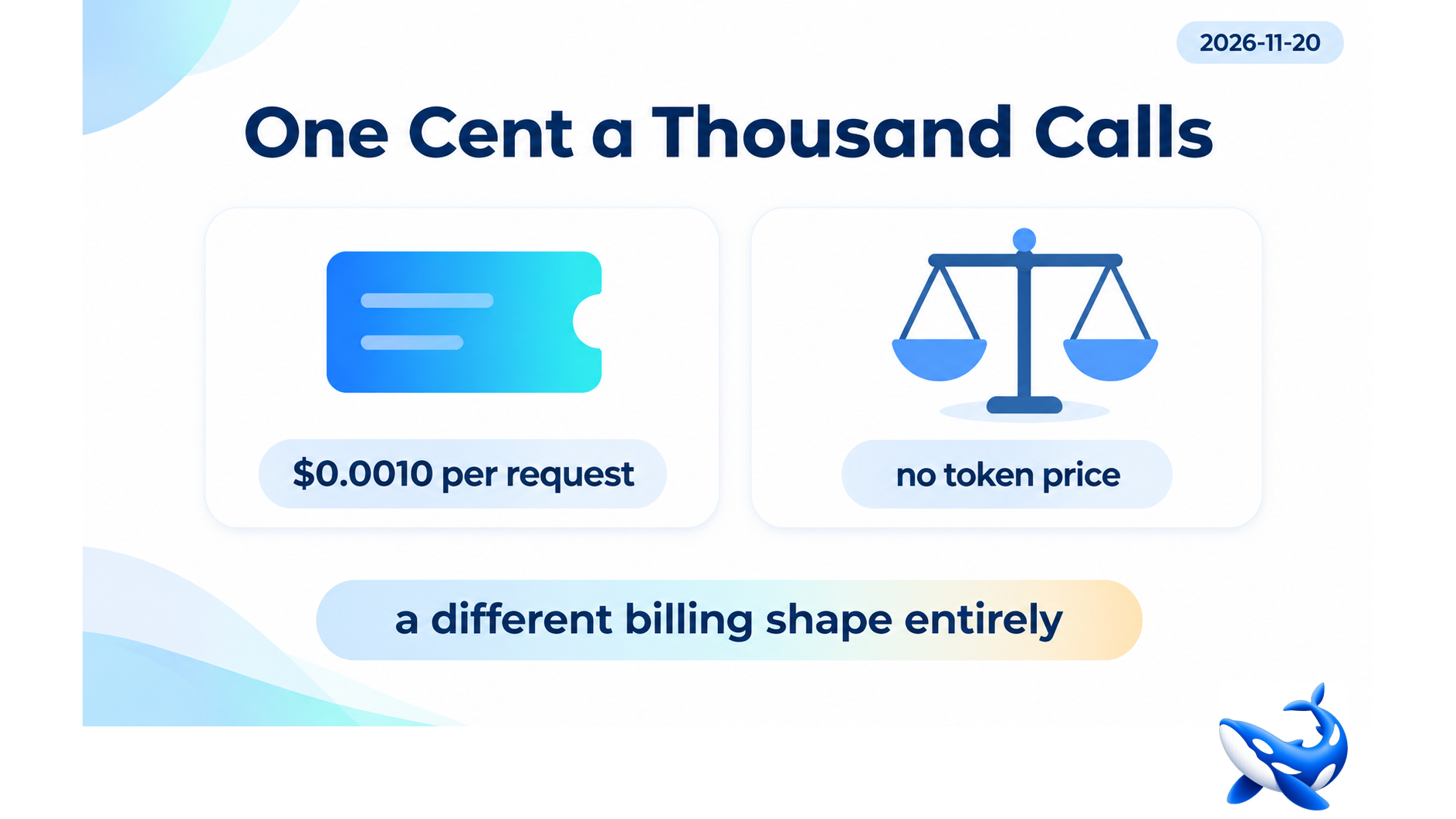
One tenth of a cent per call is the entire price of this model, and there is no per-token row to compare it against. OrcaRouter bills it per request rather than per million tokens. The row is on OrcaC2 1.0 pricing, and it is the only card in the thirteen-model cyber tier priced that way.
What the card actually publishes
| field | value |
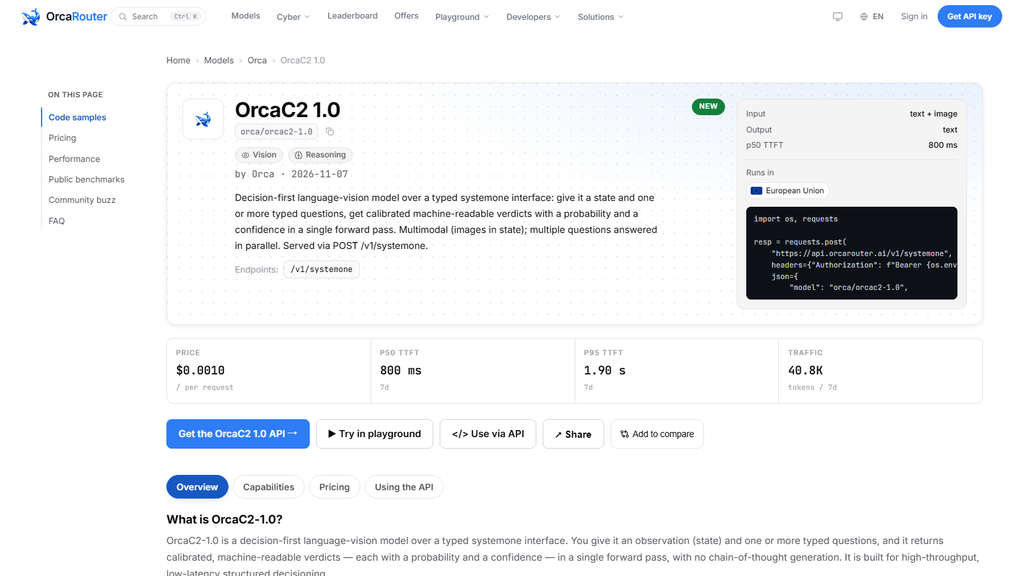
| price | $0.0010 per request |
| input / output price | none published |
| context window | not published |
| max output | not published |
| supported parameters | 2 (`reasoning`, `reasoning_effort`) |
| endpoint | `POST /v1/systemone` only |
| input modalities | text, image |
| output modalities | text |
| capabilities | vision, reasoning |
| quality score | 6 / 10 |
| release | 2026-11-07 |
Nine fields that every other cyber card publishes are absent, and the two that remain — a per-request price and an endpoint — describe a different kind of product.
`/v1/systemone` is not the chat-completions endpoint. The published description frames the model as decision-first: you send a state and one or more typed questions, and it returns calibrated verdicts with a probability and a confidence in a single forward pass. Multiple questions are answered in parallel, and no chain-of-thought is generated.
That is a classifier or a decision engine rather than an assistant. Reading its price as a token price is the first mistake available here.
Trying to express it as a token price
A token price and a request price cannot be compared without knowing the request size, and this card does not publish one. But the arithmetic can be bounded using the published throughput and latency.
At 36.9 output tokens a second and a p50 time to first token of 800 ms, a typical call emits on the order of 30 tokens. At $0.0010 per request, that is roughly $33 per million output tokens — 21× the $1.60 row and 3.3× Ultra 1.0’s $10.00.
The estimate moves a lot with the assumed answer length. At 100 tokens a call the equivalent price falls to $10 per million, which is Ultra 1.0’s row. At 1,000 tokens it is $1.00, which is below the band.
| assumed tokens per call | equivalent $/M |
| 30 | $33.33 |
| 100 | $10.00 |
| 300 | $3.33 |
| 1,000 | $1.00 |
| 10,000 | $0.10 |
So the card is expensive per token if calls are short and cheap if calls are long — the exact inverse of how a token-priced card behaves. For a decision endpoint the short case is the intended one, which means the per-token equivalent is high and irrelevant.
Where a fixed price is the right shape
A fixed per-request price removes the variable that makes token pricing hard to budget. A security pipeline that asks the same question of ten million observations knows its bill exactly: $10,000, whatever the observations contain.
The published fields support that reading. Two supported parameters and one endpoint mean the request shape is constrained, so a very long request is unlikely — the API surface does not offer a way to send one. And the model answers several typed questions in a single pass, which is what makes a per-request price efficient rather than wasteful: the alternative would be several calls.
The risk is the opposite. A fixed price per request with no published ceiling means a caller cannot reason about the cost of a pathological input, and the card’s own error rate suggests something about how inputs land.
That error rate is the next article’s subject, because 97.19% is not a number to fold into a cost model without comment.
The parameters that are missing
Every other cyber card publishes between ten and twenty-two supported parameters. This one publishes two: `reasoning` and `reasoning_effort`.
No `temperature`, no `top_p`, no `max_tokens`, no `tools`, no `response_format`, no `structured_outputs`, no `stop`. The six band cards all offer `structured_outputs` and `tools`; this one offers neither, despite returning machine-readable verdicts.
That is coherent with a fixed-output-shape endpoint — if the response schema is fixed by the API there is no need for a caller to specify `response_format` — but it does mean the usual levers for steering a model are absent. What remains is how hard it thinks, which is the one thing a caller might reasonably vary across a batch.
For a buyer the practical consequence is that this model cannot be A/B tested on prompt-level knobs the way the rest of the tier can. Any comparison against a chat model is a comparison of two different interfaces, not of two models on the same task.
Why a per-request row breaks the tier’s arithmetic
Every comparison in this tier is built on a price per million tokens. A card priced per request cannot enter that arithmetic, and the failure is not cosmetic.
| card | pricing unit | comparable to tokens? |
| twelve cards | $ per million in / out / cached | yes |
| OrcaC2 1.0 | $0.0010 per request | no |
To place it beside the others a buyer needs a tokens-per-request figure, and any such figure is a guess. At 30 tokens a request the card is $33.33 per million. At 300 tokens it is $3.33. At 3,000 it is $0.33.
| assumed tokens per request | implied $/million |
| 30 | $33.33 |
| 100 | $10.00 |
| 300 | $3.33 |
| 1,000 | $1.00 |
| 3,000 | $0.33 |
The published traffic narrows the guess slightly. Forty thousand seven hundred seventy-seven tokens over thirteen days is 3,137 tokens a day, and if the 97.19% error rate holds then the successful calls are a small fraction of attempts.
That is the whole point of a per-request row: it prices a unit the buyer controls. Where the response is short and predictable, per-request is cheap and per-token is the wrong lens. Where the response is long, the reverse.
A tier table that mixes the two without saying so invites a comparison that is arithmetically unsound. This card’s $0.0010 is a real price and it is not a price per token.
One number in the traffic column reinforces the reading. Forty thousand seven hundred seventy-seven tokens over thirteen days is 3,137 a day, which is three orders of magnitude below Hy4 Flash’s first two days. A card with a real customer base would not sit at that level for a fortnight, so the volume itself is evidence that the endpoint is being probed rather than used.
OrcaC2 1.0 is priced at $0.0010 per request with no token row, no published context window, no max output, two supported parameters and one endpoint — `POST /v1/systemone`, a decision interface rather than a chat one.
Converting to a token price gives $33 per million output at 30 tokens a call and $10 at 100, so the card is expensive per token for short calls and cheap for long ones — the inverse of a token-priced card. For a fixed-shape decision endpoint the short case is the intended one, and a per-request price is what makes the bill predictable.
It is the only card in the thirteen-model tier priced this way, and it publishes no benchmark block.
Sourcing note: the per-request price, endpoint list, supported parameters, modalities, capabilities, quality score, latency percentiles, throughput, error rate and seven-day token volume are read from the OrcaC2 1.0 model API and card page on orcarouter.ai on 2026-11-20, with latency, throughput and error rates being OrcaRouter production telemetry. The equivalent token prices are our own arithmetic on published throughput and latency and are estimates, not measurements. No competitor product is named or compared. Checked 2026-11-20.