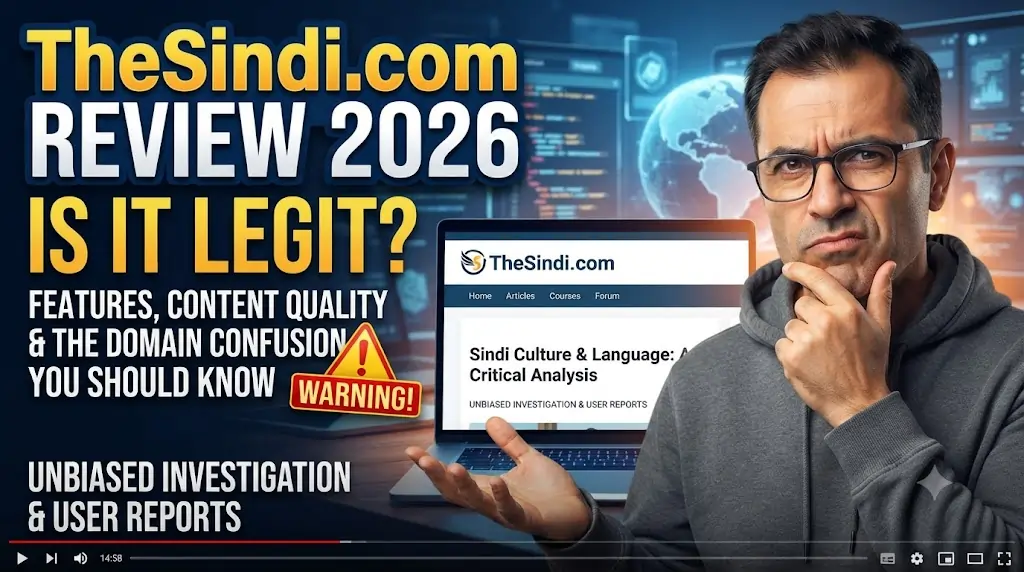
If you landed on this page because you searched “thesindi com,” there’s a good chance you’re not entirely sure which website you’re even looking at. That confusion is the story here — and it’s the one thing most reviews of this site skip entirely.
This review breaks down what TheSindi actually is, why there are multiple competing versions of it, what it publishes, and whether it’s worth your time.
The First Thing You Need to Know: There Isn’t Just One “TheSindi”
Before evaluating content quality or trustworthiness, there’s a more basic issue: a search for “thesindi com” currently surfaces at least three different websites using nearly identical branding:
| Domain | What it claims to be |
|---|---|
| thesindi.com | An informational blog covering education, lifestyle, and general topics |
| thesindi.net | A separate “TheSindi.net” brand pitching itself as free, jargon-free content on tech, finance, health, travel, and education |
| thethesindi.com | A near-identical “TheSindi com” site with the same category list and mission-statement language as the .net version |
The .net and thethesindi.com sites use almost word-for-word the same pitch — phrases like writing for “real people, not search engines” and covering “tech, finance, health, travel, and education” in “plain language.” That kind of duplicated messaging across separate domains is a red flag worth pausing on. It’s consistent with either:
- A single operator running multiple near-duplicate sites to capture more search traffic, or
- Copycat sites cloning an original’s positioning to ride its momentum
Either way, if you’re trying to verify “is thesindi.com legit,” the answer depends entirely on which domain you actually landed on — and that’s the first thing to check before reading further, sharing personal information, or trusting an article’s advice.
What Content Does TheSindi Actually Publish?
Across the various TheSindi domains, the content strategy is consistent: broad, multi-topic, beginner-facing articles rather than deep coverage of one niche. Common categories include:
- Technology — simplified explainers on gadgets, software, and digital trends
- Finance — loans, savings, insurance, and everyday money decisions
- Health — general wellness and lifestyle tips
- Travel — destination guides and travel logistics
- Education — study strategies, EdTech, and admissions-adjacent topics
Articles tend to run short, use plain language, and avoid technical jargon — a deliberate strategy aimed at readers who want a fast answer rather than an in-depth analysis. That’s a reasonable approach for surface-level questions, but it also means the content isn’t positioned (and shouldn’t be treated as) a substitute for expert advice on anything with real financial, legal, or health consequences.
Is TheSindi.com Safe and Legitimate?
Here’s a more concrete framework than “check if it has a privacy policy” — the standard advice you’ll find in most reviews of sites like this.
1. Confirm which domain you’re actually on. Given the domain overlap described above, this matters more here than on a typical site. Check the URL bar carefully — .com, .net, and lookalike variations are being used for what may be entirely separate operations with different ownership.
2. Check for author accountability, not just an About page. Anyone can put up an “About Us” page. Look for whether articles are attributed to a named author with a real bio, whether that person’s other work is verifiable elsewhere, and whether the site corrects or updates articles over time.
3. Look at how confidently claims are stated. Generic hedge phrases — “appears to,” “is likely,” “seems to” — repeated across an entire article are a sign the writer (or an AI system) doesn’t actually have direct knowledge of the topic. Genuine reporting states facts plainly and flags uncertainty only where it truly exists.
4. Treat topic breadth as neutral, not automatically positive or negative. A site covering finance, health, tech, and travel isn’t inherently untrustworthy — but it does mean no single category is likely to get expert-level depth. Judge each article on its own, not the site as a whole.
Who Should Actually Use a Site Like This?
TheSindi-style content is reasonably useful for:
- A first-pass overview before researching a topic in depth
- Simple definitional questions (“what is X, how does Y work”)
- Casual reading on lifestyle or travel topics with low stakes
It’s a poor primary source for:
- Any financial decision involving real money (loans, investments, insurance)
- Legal or medical questions
- Anything where you’d normally want a named expert or a primary source (a bank, a government agency, a licensed professional)
TheSindi vs. Established Publishers: The Real Comparison
Most “vs. established publishers” sections in reviews like this just say “big publishers have more fact-checkers.” Here’s what actually differs in practice:
| Factor | TheSindi-style sites | Established publishers |
|---|---|---|
| Publishing speed | Fast — can cover a trending topic within days | Slower, but typically reviewed before publishing |
| Depth per topic | Shallow, generalist | Deep, specialist |
| Author transparency | Often thin or generic bios | Named experts, verifiable track record |
| Source citations | Rare or absent | Common, with links to primary sources |
| Best use case | Quick orientation on an unfamiliar topic | Decisions that carry real consequences |
Quick Verification Checklist
Before trusting anything from a TheSindi domain (or any similar multi-topic content site), run through this in under two minutes:
- [ ] Confirm the exact domain (.com vs .net vs a lookalike)
- [ ] Check for a real, verifiable author name — search it independently
- [ ] Look for a visible last-updated date
- [ ] See if claims are backed by a specific source, not just stated as fact
- [ ] Cross-check any financial, legal, or health claim against a primary source (government site, bank, licensed professional)
Frequently Asked Questions
Is thesindi.com the same as thesindi.net?
No — they are separate domains. Both use similar branding and near-identical mission language, but there’s no public confirmation they share the same ownership. Treat them as separate entities until proven otherwise.
Is TheSindi safe to browse?
There’s no evidence of malicious behavior on any of the TheSindi domains as of this writing. Standard browsing precautions apply: avoid entering sensitive personal or financial information, and verify the exact URL before doing anything beyond reading.
Can I trust the finance or health articles?
Use them as a starting point only. None of the TheSindi domains show visible evidence of licensed financial or medical review, which matters for any advice you’d act on.
Why do so many “TheSindi” review articles sound the same?
Because most of them are generated using the same template — broad claims, hedged language, and generic pros/cons lists — without anyone actually verifying which domain they’re describing. That’s exactly the gap this review is meant to close.
Bottom Line
TheSindi is less a single website than a cluster of near-identical domains publishing broad, beginner-level content. Before trusting any specific claim, confirm which domain you’re actually reading, check for real author accountability, and treat anything finance-, health-, or legal-adjacent as a starting point rather than a final answer. That approach applies whether you’re reading TheSindi or any other general-interest content site.