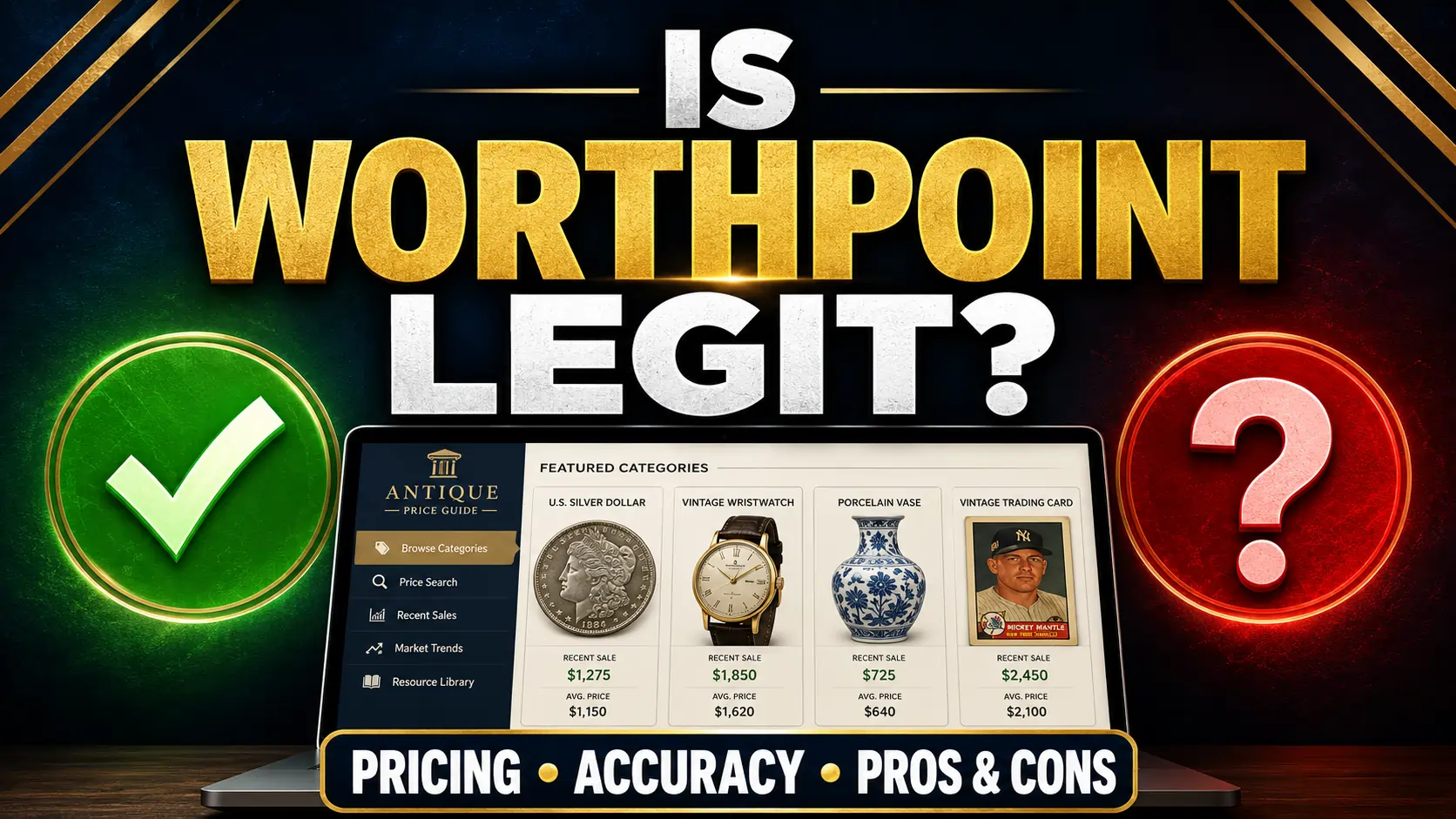
Trying to value an old coin, vintage toy, piece of jewelry, or inherited antique can be frustrating. Current marketplace listings often show what sellers want, but they do not always reveal what buyers actually paid. WorthPoint attempts to solve this problem by providing access to historical sales records for antiques, art, and collectibles.
But is WorthPoint legit, and can you trust its prices?
WorthPoint is a legitimate collectibles-research platform with a large database of past auction and marketplace sales. It can be valuable for dealers, collectors, estate-sale buyers, and frequent resellers. However, WorthPoint does not provide guaranteed valuations, and its recurring subscription has attracted complaints about pricing, automatic renewals, and cancellation experiences.
This WorthPoint review examines its legitimacy, pricing, accuracy, free trial, customer complaints, advantages, limitations, and the best WorthPoint alternatives.
Quick Verdict: Is WorthPoint Legit?
Yes, WorthPoint is a legitimate research service for antiques, art, memorabilia, and collectibles. Its Price Guide contains historical sales information collected from auction houses and online marketplaces. However, the prices are reference points rather than guaranteed appraisals. WorthPoint is most useful when you compare several closely matched items instead of relying on one old sale.
WorthPoint at a Glance
| Feature | Details |
|---|---|
| Company | WorthPoint Corporation |
| Founded | 2007 |
| Main purpose | Antique and collectible price research |
| Main database | WorthPoint Price Guide, also called Worthopedia |
| Data type | Historical auction and marketplace sales |
| Free trial | Seven days or seven lookups under published trial terms |
| Pricing | Paid monthly and annual plans |
| Best for | Collectors, antique dealers and frequent resellers |
| Main benefit | Access to older sold-price records |
| Main limitation | Historical prices may not equal current market value |
| Formal appraisal | No |
| Overall verdict | Legitimate, but best for regular researchers |
What Is WorthPoint?
WorthPoint is an online research platform that helps users identify and investigate antiques, art, vintage goods, and collectibles. It does not normally buy or sell the items shown in its database. Instead, it collects historical listing information and makes that data searchable.
The platform is commonly used to research:
- Antiques and decorative objects
- Fine art and prints
- Coins and currency
- Vintage jewelry and watches
- Ceramics and glassware
- Sports memorabilia
- Trading cards and comic books
- Dolls, toys, and games
- Military collectibles
- Books, posters, and photographs
- Fashion accessories and vintage clothing
- Advertising signs and branded memorabilia
WorthPoint reports that its wider platform contains hundreds of millions of historical sales records and a large collection of images. Its additional resources include information about makers’ marks, patterns, symbols, and collectible terminology.
The service is particularly useful when an item is rare or old enough that no recent comparable sales appear on eBay.
How Does WorthPoint Work?
Users search WorthPoint by entering information about an item, such as its maker, model, material, approximate age, pattern, or identifying mark. The system then displays related records from previous sales.
A useful search process looks like this:
- Identify the item’s brand, maker, material, and approximate age.
- Search using a detailed description rather than a broad term.
- Review images of similar sold items.
- Compare size, condition, markings, and included accessories.
- Check when and where each item sold.
- Use several relevant results to create a likely value range.
- Confirm the estimate through another marketplace or auction source.
For example, searching “vintage vase” would produce results that are too broad. Searching for “Roseville Pottery green Freesia handled vase 1940s” should return closer comparisons.
WorthPoint is therefore a research tool, not an automatic valuation machine. The usefulness of its results depends heavily on how accurately you identify and search for the item.
What Is Worthopedia?
Worthopedia is the name traditionally associated with WorthPoint’s historical Price Guide. It contains archived sales records from auction houses, estate-sale companies, and online marketplaces.
A typical record may include:
- Listing title
- Product description
- Photographs
- Recorded sale price
- Date of sale
- Marketplace or auction source
- Item measurements
- Reported condition
- Seller-provided details
Worthopedia’s main advantage is historical depth. Many marketplaces allow users to see only relatively recent completed listings. WorthPoint may provide records going back much further, making it helpful for uncommon collectibles that sell only occasionally.
However, a recorded sale price should never be treated as an automatic current valuation. A vase sold in 2016 may be worth more or less today. Buyer demand, condition, fashion trends, rarity, and selling venue can all change its market value.
What Other Tools Does WorthPoint Offer?
WorthPoint has expanded beyond its basic sold-price database. Depending on the selected membership, users may receive access to some or all of the following resources.
Price Guide
The Price Guide provides historical sales results for antiques and collectibles. It is the platform’s primary feature and the main reason most resellers subscribe.
M.A.P.S.
M.A.P.S. stands for Marks, Autographs, Patterns, and Symbols. It helps users investigate pottery marks, signatures, manufacturer logos, patterns, and other identifiers.
This feature can be useful when you recognize an object’s general category but cannot identify its maker.
Digital Library
The Library contains digitized reference materials related to antiques and collectibles. These resources may help users research an object’s origin, production history, design, or manufacturer.
WorthPoint Dictionary
The Dictionary contains reference articles explaining collectible categories, makers, materials, and related terminology.
Vault
The Vault allows users to organize information and photographs of items in a personal digital collection. It may be useful for tracking possessions, documenting collections, or keeping research in one place.
Mobile App
WorthPoint provides a mobile app for researching objects while visiting flea markets, thrift stores, garage sales, and estate sales. The app includes search and item-research functions, although user feedback about app performance is mixed. The current Google Play listing shows more than 100,000 downloads and a 2.7-star rating. Google Play
Is WorthPoint a Legitimate and Trustworthy Website?
WorthPoint is a legitimate operating company rather than an anonymous valuation website. It was founded in 2007 and provides a genuine subscription-based research product. The historical records, images, reference articles, and identification databases are real.
Its legitimacy does not mean every record is perfect or every subscriber will find the service worthwhile. Three separate questions should be considered:
- Is the business real? Yes.
- Does it provide an actual research service? Yes.
- Is every displayed price an accurate present-day valuation? No.
WorthPoint primarily aggregates sales information. Some details may have originated in seller-written marketplace listings. If an original listing incorrectly identified an object, that error could also affect its usefulness as a comparable sale.
Users should therefore treat WorthPoint as one research source rather than the final authority on an item’s identity or value.
Is WorthPoint Safe to Use?
WorthPoint operates like a standard paid subscription website and offers account access through its website and mobile apps. There is no clear basis for describing the service itself as a fraudulent payment website.
The main concern raised by users involves subscription management rather than whether WorthPoint is a real platform. Before starting a trial or paid plan, you should:
- Read the checkout page carefully.
- Confirm whether billing is monthly or annual.
- Note the trial’s exact ending condition.
- Check whether automatic renewal is enabled.
- Set a reminder before the trial expires.
- Cancel through the correct account or app-store channel.
- Keep the cancellation email or screenshot.
- Review your next bank or card statement.
Deleting the WorthPoint app does not necessarily cancel a subscription. If you subscribed through Apple or Google Play, you may need to manage the plan through the corresponding app-store account.
Is WorthPoint a Scam?
WorthPoint is not a scam in the usual sense. It provides a real searchable database and identification resources to paying subscribers.
The “WorthPoint scam” query largely appears to be connected with customer dissatisfaction involving:
- Automatic renewal after a trial
- Confusion about the seven-day or seven-lookup limit
- Unexpected monthly or annual charges
- Difficulty obtaining refunds
- Problems confirming cancellation
- Prices that users believed were inaccurate or outdated
- Searches that did not return the expected item
These complaints deserve attention, but they do not prove that the entire platform is fraudulent. They show why users need to understand the billing terms and evaluate whether the database matches their research needs before purchasing an annual plan.
How Accurate Is WorthPoint?
WorthPoint can provide accurate historical sale information, but it cannot guarantee an item’s current value. The distinction between a recorded price and a current valuation is important.
A WorthPoint result tells you that a described item reportedly sold for a certain amount at a particular time and venue. It does not prove that your item is identical or that another buyer will pay the same price today.
Accuracy depends on factors such as:
- Correct item identification
- Authenticity
- Manufacturer or artist
- Age and production period
- Rarity
- Dimensions
- Materials
- Condition
- Restoration or repairs
- Original packaging
- Provenance
- Current buyer demand
- Geographic market
- Selling platform
- Sale date
WorthPoint works best when several recent records closely match your item. Its results become less reliable when only one old or poorly described record exists.
Where Does WorthPoint Get Its Price Data?
WorthPoint says its Price Guide aggregates historical sales data from auction houses and online marketplaces. Its mobile listing describes nearly two decades of pricing information, while WorthPoint’s published materials refer to hundreds of data sources.
Records may originate from:
- Traditional auction houses
- Online auction platforms
- Regional auction companies
- Estate-sale businesses
- Online marketplaces
- Specialist collectible sellers
- WorthPoint data partners
The sources and exact coverage can change. WorthPoint also does not contain every item that has ever been sold online.
Why WorthPoint Prices Can Be Misleading
Several issues can make a recorded price unsuitable as a direct comparison.
The items may only look similar
Two ceramic figures can appear identical but come from different production periods. One may be an original, while the other is a later reproduction.
Condition may be different
Cracks, repairs, fading, missing pieces, and replaced parts can significantly reduce value. Small condition details are not always visible in archived photographs.
The record may be old
Collectible markets change. Items that were popular ten years ago may have less demand today, while previously overlooked categories may become more valuable.
Selling costs may not be clear
Auction premiums, taxes, shipping charges, and seller fees can affect what the buyer paid and what the seller actually received.
Best-offer prices can create uncertainty
A listing may display its original price even if the seller accepted a lower offer. Depending on the source record, the displayed amount may not always represent the final negotiated price.
The original listing may contain errors
WorthPoint relies partly on information supplied by sellers and auctioneers. A wrongly attributed artist, date, material, or manufacturer can lead to a misleading comparison.
How to Use WorthPoint Prices Correctly
Use this process to create a more dependable estimate:
- Find at least three to five closely matching sold records.
- Prioritize records with clear photographs and complete descriptions.
- Compare dimensions, materials, markings, and condition.
- Give more weight to recent sales.
- Separate auction results from ordinary marketplace sales.
- Remove unusually high and low prices unless there is a clear reason for them.
- Compare the remaining results with eBay, LiveAuctioneers, or another source.
- Present the result as a price range rather than one exact figure.
Suppose five relevant records show prices of $80, $90, $95, $110, and $400. The $400 result should not automatically raise the expected value. It may involve exceptional condition, important provenance, or an inaccurate listing. A cautious estimate might remain around $80 to $110 until the unusual result is verified.
WorthPoint vs. a Professional Appraisal
WorthPoint and professional appraisals serve different purposes.
| Factor | WorthPoint | Professional Appraisal |
|---|---|---|
| Main purpose | Price and identification research | Expert valuation |
| Method | Historical comparable sales | Specialist examination and market research |
| Physical inspection | No | Often required |
| Cost | Subscription fee | Appraisal fee |
| Best for | Reselling and general research | Insurance, estates, taxes and legal matters |
| Written valuation report | No formal appraisal report | Usually available |
| Guaranteed sale price | No | No, but supported by expert analysis |
Use WorthPoint when deciding whether an item may be worth buying or listing. Use a qualified appraiser when the valuation will affect insurance, taxation, inheritance, charitable donation, division of property, or a major financial decision.
How Much Does WorthPoint Cost?
WorthPoint uses monthly and annual subscriptions. Pricing can vary by plan, platform, location, and promotion.
As of July 2026, WorthPoint’s indexed product information shows a Price Guide plan at approximately $28.99 per month or $259.99 annually. Other indexed prices and app-store options show higher rates for plans that include Marks or broader access.
| Plan | Approximate Published Price | Main Access |
|---|---|---|
| Price Guide | $28.99 monthly or $259.99 annually | Historical sales records |
| Price Guide + Marks | Around $37.99 monthly | Price Guide and identification database |
| Broader or all-access plan | Around $39.99–$46.99 monthly | Price Guide, Marks and additional research tools |
Apple’s US App Store currently lists options including Price Guide Monthly at $26.99, Price Guide Annual at $249.99, and Price Guide + MARKS Monthly at $37.99. Prices can differ between direct website subscriptions and app-store purchases. Apple App Store
Always confirm the total displayed on the final checkout page. An annual plan can produce a large one-time charge even when the offer describes its equivalent monthly cost.
Does WorthPoint Offer a Free Trial?
WorthPoint’s published terms describe a trial that lasts for seven days or seven lookups, subject to the offer shown during enrollment. Users may use the available lookups on one item or multiple items. WorthPoint Terms of Use
The subscription may begin automatically once the trial ends or its allowed lookups are used. Because promotional terms can change, read the current enrollment screen before entering payment information.
A safe approach is to:
- Record the date and time you joined.
- Take a screenshot of the trial conditions.
- Check what counts as a lookup.
- Set a cancellation reminder.
- Cancel early if the database does not meet your needs.
- Save proof that the cancellation succeeded.
Is WorthPoint Free?
WorthPoint allows visitors to view some public pages and limited information, but unrestricted access to detailed historical prices generally requires a paid subscription.
If you only need to research one common object, it may be better to begin with free tools such as:
- eBay sold listings
- Google Lens
- Facebook Marketplace
- Auction-house archives
- Collector forums
- Local antique dealers
WorthPoint becomes more useful when you regularly research rare objects whose older sales records no longer appear on free marketplaces.
Is WorthPoint Worth the Money?
WorthPoint’s value depends on how frequently you use it and what you research.
It may be worth paying for if you:
- Buy inventory at estate sales or auctions
- Sell antiques or vintage items regularly
- Need older sales data for rare objects
- Research items with few current eBay comparisons
- Work with several collectible categories
- Can recover the subscription cost through better purchasing decisions
It may not be worth it if you:
- Need only one item researched
- Sell inexpensive household goods
- Can find enough recent eBay sales for free
- Expect the service to produce an exact appraisal
- Rarely encounter unusual antiques
- Do not want an automatically renewing subscription
For a reseller, avoiding one bad $100 purchase could cover several months of membership. For someone researching a single common ornament, the subscription may cost more than the information is worth.
How to Cancel a WorthPoint Subscription
The precise steps may vary depending on where the subscription was purchased.
For a website subscription:
- Sign in to your WorthPoint account.
- Open the account or membership settings.
- Locate the subscription-management option.
- Choose the cancellation option.
- Complete every confirmation step.
- Save the confirmation page or email.
- Verify that the account shows no future renewal.
For an Apple or Google Play purchase, cancel through the subscription settings of the relevant app store.
WorthPoint’s Google Play listing states that subscriptions automatically renew on the selected monthly or annual term and may be managed through the user’s account. It also states that there are no cancellation fees. Google Play
If you cannot access your account, contact WorthPoint support promptly and keep a record of the request.
Common WorthPoint Billing and Cancellation Complaints
WorthPoint has received mixed customer feedback. Trustpilot displayed a score of approximately 2.4 out of 5 based on 411 reviews when checked in July 2026. Negative reviewers frequently mentioned trial charges, renewals, cancellations, refunds, and customer service. Positive reviewers praised the research database and helpful support representatives. Trustpilot
Common complaint themes include:
- A charge appearing after a free trial
- Users overlooking the lookup limit
- Confusion between annual and monthly billing
- Believing an account was cancelled when renewal remained active
- Difficulty obtaining a requested refund
- Slow support responses
- Problems with the mobile app
- Poor results for a particular item
Online reviews represent individual experiences and cannot independently prove what occurred in every case. However, the repeated billing concerns make it sensible to document the trial, cancellation, and renewal status.
Can You Get a WorthPoint Refund?
A refund is not guaranteed. Eligibility depends on WorthPoint’s current terms, the subscription channel, the timing of the request, and the circumstances surrounding the charge.
If you believe you were charged incorrectly:
- Confirm whether the payment came from WorthPoint, Apple, or Google.
- Check the subscription and trial dates.
- Find any cancellation confirmation.
- Contact the correct billing provider immediately.
- Include the charge date, amount, and account email.
- Ask for written confirmation of the decision.
- Continue monitoring the account for future renewals.
Do not wait several months to report an unwanted charge. A prompt, clearly documented request is more likely to be investigated properly.
WorthPoint Pros and Cons
| Pros | Cons |
|---|---|
| Large archive of historical sales | Full price access requires a subscription |
| Useful for rare and discontinued items | Old prices may not reflect today’s demand |
| Includes photographs and descriptions | Records may repeat seller errors |
| Helpful maker-mark resources | Not a certified appraisal |
| Saves time for frequent resellers | Limited value for one-time users |
| Covers many collectible categories | Trial and renewal terms require attention |
| Provides older data than many free tools | Some users report app and support problems |
Who Should Use WorthPoint?
WorthPoint is best suited to people who research collectibles regularly.
WorthPoint May Be Suitable For
- Antique dealers
- Professional resellers
- Auction buyers
- Estate-sale shoppers
- Dedicated collectors
- Vintage jewelry sellers
- Flea-market vendors
- Users researching uncommon objects
WorthPoint May Not Be Suitable For
- One-time users
- Casual sellers of common products
- People needing a legal or insurance appraisal
- Users expecting guaranteed prices
- Sellers who already find enough free comparable sales
- Anyone unwilling to manage a recurring subscription
Best WorthPoint Alternatives
No single WorthPoint alternative covers every collectible category. The best choice depends on what you are researching.
1. eBay Sold Listings
eBay sold listings are one of the best free options for checking current resale value. They show whether similar products have recently sold and help users compare asking prices with actual market activity.
Best for: Toys, fashion, electronics, trading cards and common collectibles
Main advantage: Free and current
Main limitation: Shorter historical coverage
2. Google Lens
Google Lens can help identify an unknown object from a photograph. It is useful for finding similar images, product names, maker information, and related listings.
Best for: Initial visual identification
Main advantage: Fast and free
Main limitation: A visual match does not confirm authenticity or value
3. LiveAuctioneers
LiveAuctioneers provides access to auctions involving art, jewelry, furniture, antiques, and collectibles. Archived listings can offer useful specialist descriptions and sale results.
Best for: Art, furniture and traditional antiques
Main advantage: Auction-house context
Main limitation: Some information may require an account
4. Invaluable
Invaluable works with auction houses and covers categories such as fine art, jewelry, decorative objects, watches, and collectibles.
Best for: Higher-value art and antiques
Main advantage: Specialist auction listings
Main limitation: Less helpful for ordinary resale goods
5. Heritage Auctions
Heritage Auctions has detailed archives for coins, currency, comics, sports memorabilia, entertainment items, and other specialist collectibles.
Best for: Coins, comics and high-value memorabilia
Main advantage: Detailed catalog descriptions
Main limitation: Narrower focus than WorthPoint
6. eBay Product Research
Previously associated with the Terapeak name, eBay Product Research helps sellers examine marketplace demand, sold items, and pricing trends.
Best for: Active eBay sellers
Main advantage: Relevant marketplace data
Main limitation: Focused primarily on eBay activity
7. Professional Appraisers
A qualified specialist can physically inspect an item, consider authenticity and condition, and provide a documented opinion of value.
Best for: Expensive, inherited, insured or disputed property
Main advantage: Expert analysis
Main limitation: Costs more than database research
WorthPoint vs. Alternatives
| Platform | Best For | Free Access | Historical Depth | Formal Appraisal |
|---|---|---|---|---|
| WorthPoint | Broad collectible research | Limited | Strong | No |
| eBay sold listings | Recent resale prices | Yes | Limited | No |
| Google Lens | Visual identification | Yes | Low | No |
| LiveAuctioneers | Antiques and auction results | Varies | Good | No |
| Invaluable | Fine art and specialist auctions | Varies | Good | No |
| Heritage Auctions | Specialist collectibles | Yes/varies | Strong | No |
| Professional appraiser | Documented valuation | No | Uses several sources | Yes |
How to Value Antiques Without WorthPoint
You can build a useful valuation without paying for WorthPoint:
- Photograph the item from several angles.
- Record all signatures, labels, stamps, and numbers.
- Use Google Lens to identify possible matches.
- Search eBay’s completed and sold listings.
- Check specialist auction archives.
- Compare only items with similar condition and dimensions.
- Ask a relevant collector group or dealer.
- Use an appraiser if the item may be valuable.
Avoid relying on active listings alone. A seller can ask any price, but that does not mean a buyer has agreed to pay it.
Final Verdict: Is WorthPoint Worth It?
WorthPoint is legitimate and can be a valuable research platform for collectors, antique dealers, and frequent resellers. Its biggest advantage is access to older sold-price records that may no longer be available through free marketplace searches.
Its biggest limitation is that historical sales do not guarantee current value. Results must be checked for condition, age, authenticity, sale date, and relevance. WorthPoint should support a valuation, not replace careful research or a professional appraisal.
The subscription is more likely to be worthwhile for someone researching multiple unusual items every month. Casual users should begin with eBay sold listings, Google Lens, and free auction archives. Anyone starting a WorthPoint trial should read the renewal terms, monitor the lookup limit, and retain proof of cancellation.
Frequently Asked Questions
Is WorthPoint legitimate?
Yes. WorthPoint is a legitimate subscription platform that provides historical sales records and identification resources for antiques, art, and collectibles.
Is WorthPoint accurate?
WorthPoint can accurately show a historical recorded sale, but that does not guarantee the current value of another item. Accuracy depends on finding recent, closely matched comparisons.
Does WorthPoint show actual sold prices?
WorthPoint primarily presents prices associated with historical auction and marketplace records. Users should still check whether fees, negotiated offers, or listing errors may have affected the displayed amount.
Is WorthPoint a professional appraisal service?
No. WorthPoint is a research database, not a substitute for a qualified appraisal prepared for insurance, tax, estate, donation, or legal purposes.
How much is WorthPoint per month?
Indexed pricing in July 2026 shows the basic Price Guide at roughly $28.99 per month, with broader plans costing more. Prices can vary by platform and promotion, so confirm the checkout total.
Can you use WorthPoint for free?
Some public information is available without payment, but detailed and unlimited access to historical prices generally requires a subscription.
How long is the WorthPoint free trial?
WorthPoint’s published terms describe a trial lasting seven days or seven lookups. The exact offer shown during signup should be treated as the controlling term.
Does WorthPoint automatically renew?
WorthPoint subscriptions generally renew automatically according to the selected monthly or annual billing term unless cancelled.
Can WorthPoint identify antiques?
WorthPoint can assist with identification through listing photographs, descriptions, makers’ marks, patterns, signatures, and reference resources. It cannot guarantee authenticity from a visual match alone.
Is WorthPoint better than eBay?
WorthPoint offers deeper historical records, while eBay is often better for recent sales and current demand. Frequent antique researchers may benefit from using both.
What is the best free WorthPoint alternative?
eBay sold listings are the strongest free alternative for recent resale prices. Google Lens is useful for identification, while auction-house archives can provide specialist results.
Is WorthPoint useful for Etsy and eBay sellers?
Yes, particularly for sellers handling vintage, rare, or discontinued products. It may be unnecessary for common items with many recent sold listings.
Why are some WorthPoint prices outdated?
WorthPoint preserves historical sale records, including older transactions. Those prices remain useful for research but may no longer represent current buyer demand.
Can I cancel WorthPoint at any time?
Paid plans can generally be cancelled before the next renewal. The cancellation method depends on whether the subscription was purchased through WorthPoint, Apple, or Google Play.